Define the deliverable
Build a consulting booking-request site: service list, contact form, saved request and an operator view. Receiving a request does not reserve a time slot. Exclude payments, calendar sync and automatic email from the first version. If an existing booking service already solves the problem, use it before commissioning a custom application.
What the documentation establishes
| Candidate | Documented scope | Check in your trial |
|---|---|---|
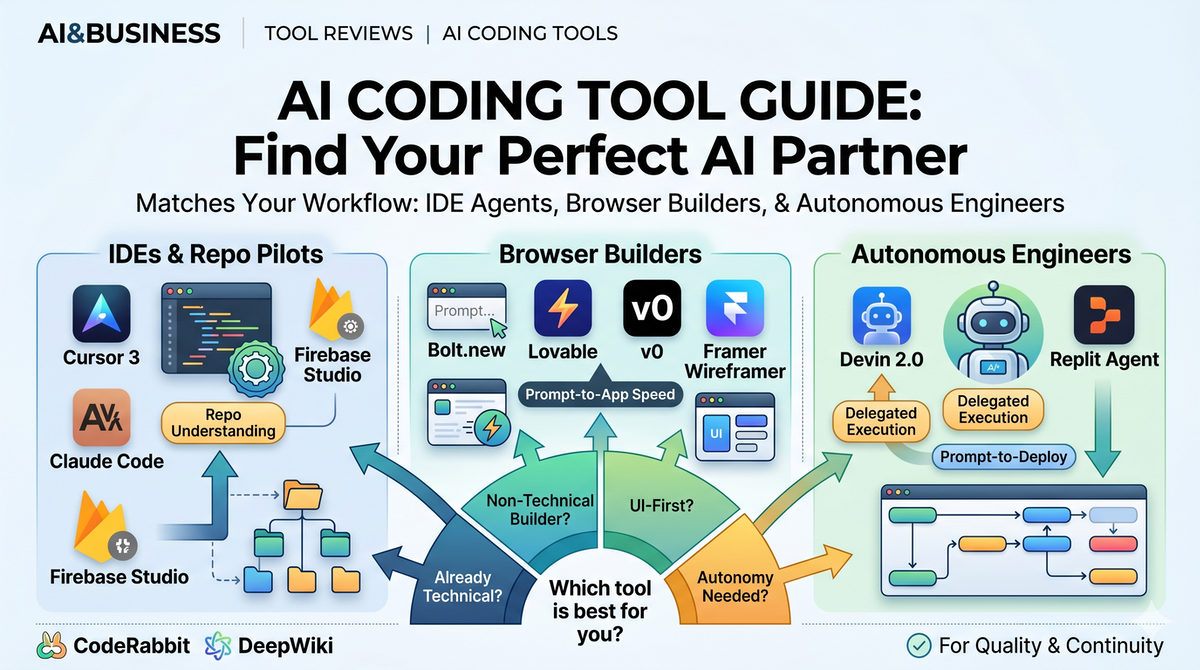
| Lovable | Natural-language application building, including frontend, backend, data and authentication | Data access rules and ability to take over the exported code |
| Replit Agent | AI-assisted application creation and iteration | Runtime, publishing process and ongoing costs |
| v0 | Full-stack applications, not only interface mockups | Compatibility with your existing code and deployment workflow |
Sources: Lovable, Replit, v0. Vendor documentation establishes advertised capabilities, not the quality of a particular generated application.
Choose one candidate from your constraints
Our editorial suggestion: include v0 early if you already maintain a Next.js project; try Lovable if you want to describe both interface and data flows; try Replit if a shared build-and-run environment is a priority. These are trial starting points, not measured winners. Their capabilities overlap.
Give each candidate the same brief: create a service list and a name/email/request form, persist submissions and provide an operator-only request list. Use fictional data. Require server-side access control; hiding a button is insufficient. Explain where data lives and how to run, publish and export the project. Do not claim a booking is confirmed or an email is sent.
Accept the workflow before rating the page
Check empty-form validation, a successful submission, unauthorized access to the operator list, persistence after refresh, a service-name change that leaves submission working, and documented setup from exported code. A permission failure stops release. Passing these checks is not a comprehensive security assessment.
Download the shared task and recording sheet. Save initial output, correction prompts, final output and failures. Leave unperformed tests blank.
Record subscription cost, generation usage, hosting, data services, domain costs and maintenance time separately. Current amounts depend on the account and plan; check official billing. Set a time and spending limit before the trial. If the core workflow still fails at that limit, stop polishing and reconsider scope or tool.